Real examples

Browse output by category, not by guesswork.

These examples were generated with the live app, saved in this codebase, and structured for quick evaluation. Pick the category closest to your use case, preview the learning flow, and download the SCORM package if you need proof of delivery.

Compliance & RiskLeadership & ManagementCustomer ExperienceEducation & AcademiaHealth & CareCommercial & Marketing

Real generated examples

12

Created with the live app and saved in the repo

Total sections

117

Questions, decisions, feedback, and context blocks

Average runtime

18 min

48 learning objectives across the current set

Live examples

See what intle creates

These are real outputs — generated from a single prompt. Click through, answer questions, make decisions. Everything you see is interactive.

QQuiz15 min

Food Allergen Awareness for Front-of-House Staff: UK Practical Quiz

Generated from a single prompt: “Create a food allergen awareness quiz for hospitality front-of-house staff covering the 14 major allergens, Natasha's Law and PPDS labelling, cross-contamination risks in a busy kitchen, and how to answer customer allergen questions safely. UK context, practical situations rather than textbook definitions.

Answered
0/2
Correct
0
Time
0:00

When a customer asks about sesame

Important
1 min
A customer tells you they have a severe sesame allergy and points to a grab-and-go chicken wrap during a busy service. The risk is not only sesame in the recipe, but also hidden ingredients, outdated assumptions, and cross-contact from prep or display. The safest approach is to stop guessing, check the written allergen information, get a precise kitchen confirmation if needed, and be honest about any uncertainty.
  • Never rely on memory for allergen advice.
  • Check written allergen information before answering.
  • If certainty is not possible, say so clearly and do not imply the food is safe.

Safe allergen query response path

Use a written-source-first process before giving any reassurance to a customer with an allergy.

graph TD
A[Customer asks] --> B[Pause service guesswork]
B --> C[Check written allergen info]
C --> D[Ask kitchen specifics]
D --> E[Confirm recipe and handling]
E --> F[Explain clearly to customer]
F --> G[If unsure, do not recommend]
Made with intle.co.uk
SCScenario20 min

Year 9 Safeguarding Disclosure: Teacher Decision Path

Generated from a single prompt: “Build a branching scenario for secondary school teachers: a Year 9 pupil starts to disclose a safeguarding concern at the end of a lunchtime club. Practise listening without leading questions, reassuring without promising confidentiality, recording what was said accurately, and reporting to the designated safeguarding lead in line with Keeping Children Safe in Education.

Answered
0/1
Correct
0
Time
0:00

A pupil asks you to keep a disclosure secret

Scenario
2 min
At the end of a lunchtime club, a Year 9 pupil waits until everyone else has left and says quietly, "I need to tell you something about home, but you can't tell anyone." In that moment, your tone, wording, and next steps affect both the pupil's trust and the school's ability to protect them. Your role is not to investigate or judge the truth of what you hear; it is to listen, avoid leading the pupil, make clear you cannot keep safeguarding information secret, and pass the concern on promptly through the school's safeguarding route.
  • Stay calm and let the pupil speak in their own words.
  • Do not promise confidentiality or start investigating.
  • Record facts and report promptly to the DSL or deputy.

Teacher response from disclosure to report

A high-level path showing the immediate safeguarding actions expected when a pupil begins to disclose harm.

graph TD
A[Pupil starts talking] --> B[Listen calmly]
B --> C[Reassure support]
C --> D[Explain no secrecy]
D --> E[Record exact words]
E --> F[Report to DSL]
Made with intle.co.uk
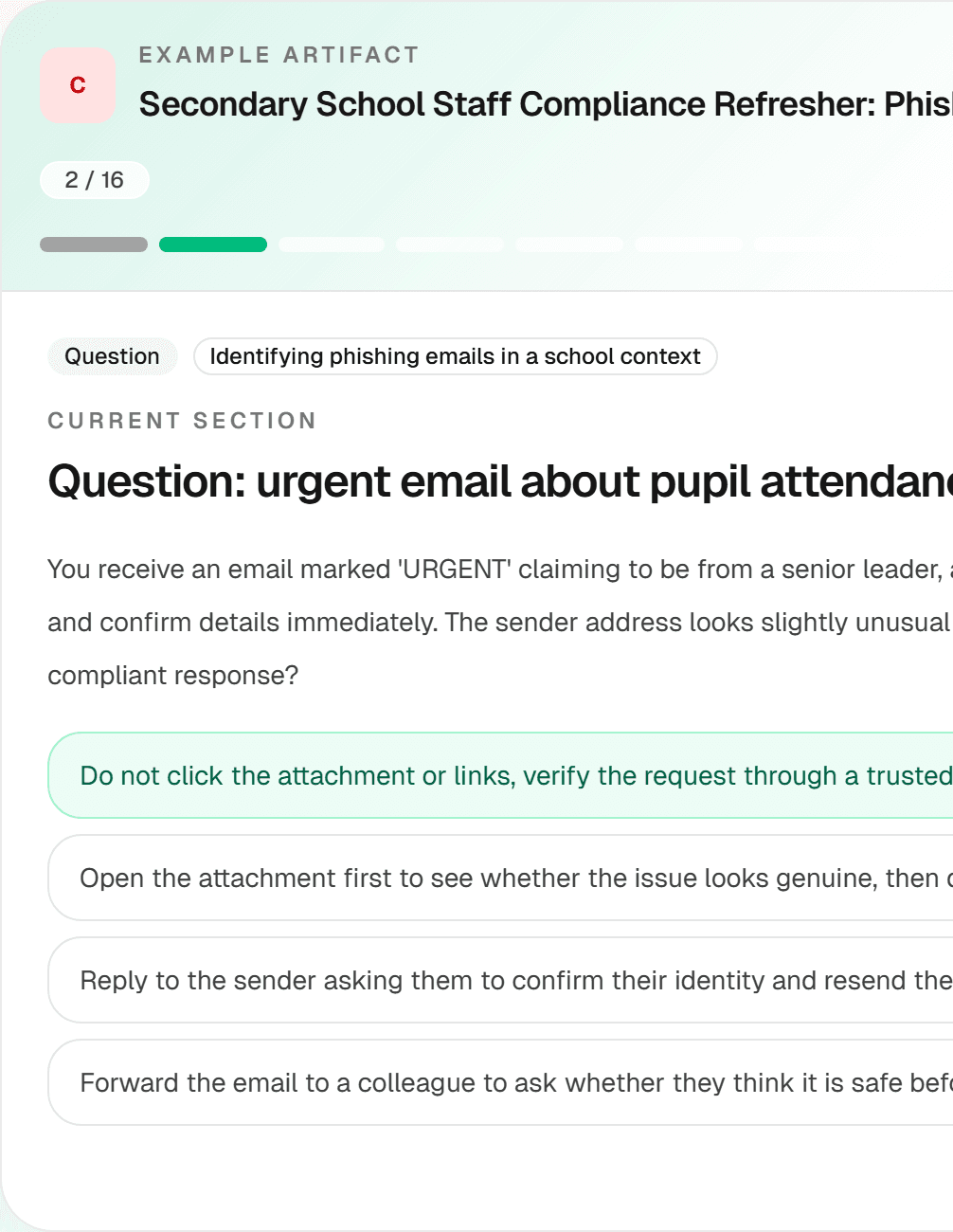
CCompliance25 min

School Staff Cybersecurity and Data Protection Refresher

Generated from a single prompt: “Create a compliance refresher for secondary school staff on identifying phishing emails, protecting pupil data, handling device security, and reporting a suspected data breach. Make it practical, policy-aware, and suitable for non-technical staff.

Answered
0/1
Correct
0
Time
0:00

Urgent Request Before Parents' Evening

Scenario
2 min
At 3:40 pm, a teacher receives an email that appears to be from the deputy head, marked urgent before parents' evening. It asks for a spreadsheet of pupil contact details and attendance concerns to be sent immediately, using a reply address the teacher does not recognise. In schools, a rushed response to an unusual request can expose personal data before anyone notices the warning signs.
  • Urgency is a common manipulation tactic.
  • Unusual requests for pupil data need extra checking.
  • Sender, links, and requested action should all be verified.

Legitimate school emails vs phishing cues

Use these clues together. A phishing message often combines urgency, unusual requests, and links or attachments that do not fit normal school practice.

CheckLegitimate cuePhishing red flag
SenderRecognisable school domainLookalike or external address
ToneRoutine and specificUrgent pressure to act now
LinksKnown school system URLMismatched or shortened link
RequestNormal role-based requestAsks for bulk pupil records
AttachmentsExpected file type/contextUnexpected file or password
Made with intle.co.uk
MLMicrolearning5 min

Handling Cancellation Requests with Empathy

Generated from a single prompt: “Create a microlearning module for customer support teams on handling subscription cancellation requests with empathy, diagnosing the root cause, and offering the best next step without sounding pushy.

Answered
0/2
Correct
0
Time
0:00

Acknowledge, Diagnose, Then Guide

Scenario
1 min
When a customer says, "Please cancel right now—I’m done," the first reply shapes the whole conversation. If you push too quickly to save the account, frustration usually rises; if you process the cancellation with no questions, you may miss a fix the customer actually wants. A strong approach is simple: acknowledge the emotion, ask one or two neutral questions to diagnose the reason, then guide the customer to the next step that best fits their situation.
  • Lead with empathy before problem-solving.
  • Use neutral questions to uncover the real reason.
  • Recommend the next step that fits the cause—even if that step is immediate cancellation.
Made with intle.co.uk
Prompt to output

Show the transformation, not just the inventory.

The examples page now explains how one plain-language request becomes structured learning output, giving buyers evidence beyond static marketing copy.

1. Prompt in

Start with a single brief.

“Create a compliance refresher for secondary school staff on phishing, pupil data, device security, and breach reporting.”

2. Structured learning out

intle turns it into sections, checks, and feedback.

The current set already shows 117 sections spanning scored questions, decision points, key takeaways, and practical context blocks.

3. Delivery ready

Preview online or package for the LMS.

Each example on this page can be previewed and exported as a standards-targeted SCORM package for operational testing.

Example collections

Popular use-case collections

These collection pages turn broad search intent into tighter proof. They work as quick entry points for buyers who know the topic they care about before they know the exact format.

Browse the full examples library

Compliance & Risk

Compliance training examples

Review policy-aware compliance learning with scored checks, clear structure, regulation context, and delivery proof for LMS or hosted rollout.

4 live examples23 min average runtimeCompliance, Quiz, Presentation
Open collection

Branching practice

Scenario-based learning examples

Explore branching learning flows that surface consequences, feedback, and coaching moments instead of generic multiple-choice content.

2 live examples20 min average runtimeScenario
Open collection

Leadership & Management

Leadership training examples

Review leadership learning examples designed around feedback, accountability, psychological safety, and team follow-through.

2 live examples13 min average runtimeScenario, Microlearning
Open collection

Customer Experience

Customer service training examples

Review customer-facing learning output focused on service quality, retention conversations, empathy, and practical next-step guidance.

1 live example5 min average runtimeMicrolearning
Open collection

Safeguarding

Safeguarding training examples

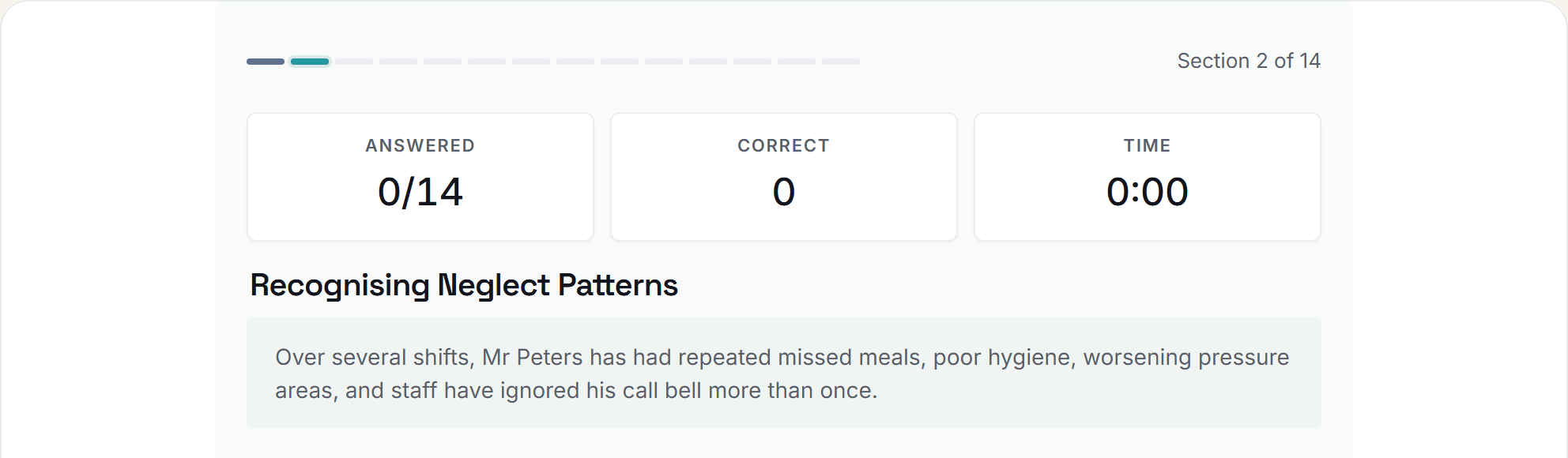
Review safeguarding learning built for real duties: KCSIE-aligned disclosure handling for teachers and Care Act 2014 competency checks for care staff.

2 live examples23 min average runtimeScenario, Assessment
Open collection

Education & Academia

Training examples for universities & schools

Review education-ready output: academic integrity seminars with live polls, first-seminar icebreakers, safeguarding scenarios, and staff data-security refreshers.

4 live examples21 min average runtimeInteractive Session, Icebreaker, Scenario, Compliance
Open collection

Security awareness

Cyber security training examples

Review security awareness output built around current threats: phishing recognition, MFA fatigue, device security, and incident reporting with scored checkpoints.

2 live examples23 min average runtimePresentation, Compliance
Open collection
Featured case studies

Go deeper into the strongest examples on the page.

The gallery helps people browse quickly. This section does the slower proof work: what the prompt asked for, what the learner experiences, and why the output is strong enough to review seriously.

Back to the gallery controls
Preview screenshot of the School Staff Cybersecurity and Data Protection Refresher example
Compliance & RiskCompliance

Best moment

The "Lost USB Drive on the Bus" decision, where all four choices play out with severity-graded consequences — from "Delay increases risk" to "Fast escalation protects the school and pupils" — each tied to a UK GDPR reference.

Schools and multi-academy trustsAnnual compliance refresherSCORM + hosted

School Staff Cybersecurity and Data Protection Refresher

A ready-to-deploy phishing and pupil-data-protection refresher for secondary school staff, generated from one short prompt and mapped throughout to UK GDPR and school policy.

Prompt snapshot

Create a compliance refresher for secondary school staff on identifying phishing emails, protecting pupil data, handling device security, and reporting a suspected data breach. Make it practical, policy-aware, and suitable for non-technical staff.

Why teams review it

Every question explanation cites the specific UK GDPR article and school policy it tests, and each wrong answer carries its own targeted feedback, so staff learn why an option fails rather than just that it does.

Objectives

4

Duration

25 min

Difficulty

Intermediate

8 scored questions6 response modes80% pass mark
Preview screenshot of the Safeguarding Adults End-of-Induction Competency Assessment for Care Home Staff example
Health & CareAssessment

Best moment

The "Witnessing Rough Handling" decision grades four responses from optimal to dangerous, including an "acceptable" trap where recording the facts without reporting first falls short — each consequence carries its own Care Act reference.

New care home staffInduction competency assessmentSCORM + hosted

Safeguarding Adults End-of-Induction Competency Assessment for Care Home Staff

An end-of-induction safeguarding adults competency assessment for new care home staff, generated from one prompt and grounded in Care Act 2014 duties.

Prompt snapshot

Create an end-of-induction competency assessment for new care home staff on safeguarding adults: types and signs of abuse and neglect, responding to a disclosure, recording accurately, escalation and whistleblowing, and duties under the Care Act 2014. Pass mark suitable for a mandatory training record.

Why teams review it

Every scored item pairs its answer with a common-mistake note and a named Care Act 2014 reference, and six response modes — from ordering a disclosure response to matching the six safeguarding principles — test the same duties from different angles.

Objectives

4

Duration

25 min

Difficulty

Intermediate

11 scored checks6 response modes80% pass mark
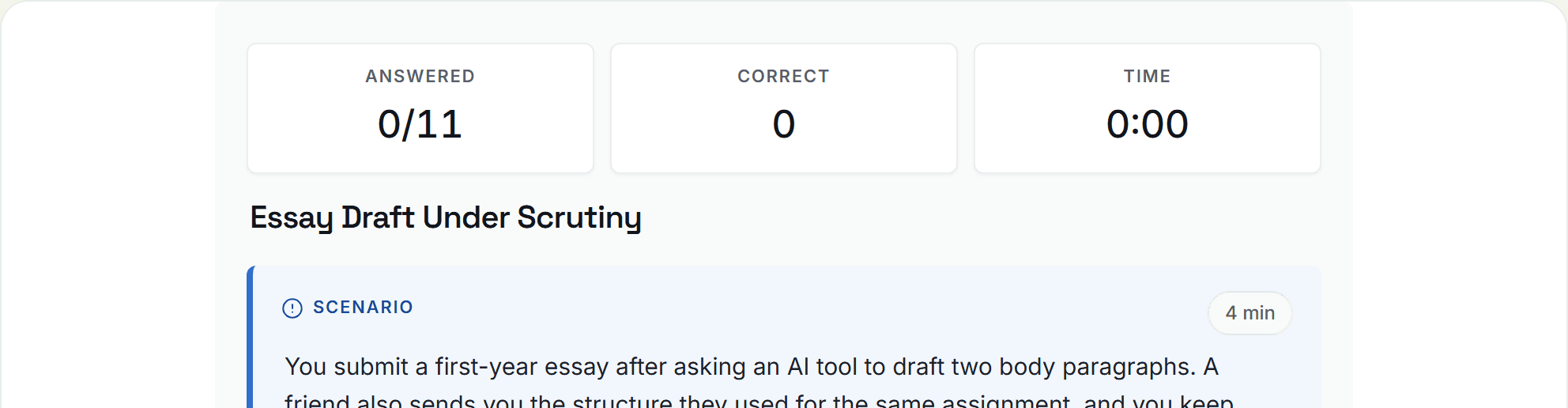
Preview screenshot of the Academic Integrity and Responsible AI: Student Decisions in Practice example
Education & AcademiaInteractive Session

Best moment

The "AI Rewrite Offer Before Submission" decision is the strongest section: each of its three options carries a consequence with a severity rating and regulation reference, backed by a "Four checks before using AI text" flowchart.

Higher education teaching staffAcademic integrity seminarHosted-first + SCORM

Academic Integrity and Responsible AI: Student Decisions in Practice

A ready-to-run interactive seminar on academic integrity and responsible AI use for first-year undergraduates, mixing live polls and paired discussion with scored knowledge checks.

Prompt snapshot

Create an interactive seminar session for first-year undergraduates on academic integrity and responsible AI use: what counts as plagiarism and collusion, when AI tools are and are not acceptable, referencing basics, and the consequences of misconduct. Use polls, word clouds, and paired discussion around realistic student cases.

Why teams review it

The session runs judgement-first — facilitator notes tell the tutor to gather reactions and run the poll before naming any rule, so students test their instincts on realistic cases such as a shared paragraph or an AI-drafted essay before the answer is revealed.

Objectives

4

Duration

30 min

Difficulty

Intermediate

4 scored checks5 visual sections70% pass mark
Compare formats

Choose the right learning format before you generate.

Not every request should become the same type of learning output. This matrix helps visitors match the format to their delivery goal, interaction style, and review workflow.

Use this section when

A buyer knows the topic but has not decided whether they need a quiz, scenario, microlearning, compliance refresher, or a more facilitator-led format.

FormatBest forInteraction styleTypical durationLMS-friendlyHosted supportNext step

Compliance

Live example available
Policy refreshers, risk awareness, and standards trainingContext panels, scored checks, key points, and reporting guidance10 to 20 minExcellentYesReview example

Scenario

Live example available
Manager judgement, behavioural practice, and coaching follow-upBranching decisions, consequences, and reflection moments8 to 18 minExcellentYesReview example

Microlearning

Live example available
Fast reinforcement, refreshers, and in-the-flow supportShort questions, quick checks, and one clear takeaway3 to 7 minExcellentYesReview example

Module

Live example available
Structured topic overviews and blended learning journeysContexts, readings, questions, and sequenced takeaways10 to 25 minExcellentYesReview example

Quiz

Live example available
Knowledge checks, certifications, and score-led validationScored questions with instant feedback and pass criteria5 to 12 minExcellentYesReview example

Interactive Session

Live example available
Live workshops, facilitated sessions, and group participationPrompts, reveals, scoring, and collaborative moments15 to 45 minGoodPrimary modeReview example

Assessment

Live example available
Formal evaluations, readiness checks, and gated progressionScored questions, completion rules, and clear outcomes8 to 15 minExcellentYesReview example

Presentation

Live example available
Briefings, share-outs, and facilitator-led communicationSlide-led content with optional checkpoints10 to 20 minGoodYesReview example

Icebreaker

Live example available
Kickoffs, energisers, and short team warm-upsFast prompts, participation cues, and low-friction activity2 to 6 minLightweightPrimary modeReview example
Delivery proof

SCORM export and testing are part of the workflow.

The current example set is useful for buyer evaluation because it demonstrates structure, scored progression and downloadable export formats.

Evidence status

Dated package-level SCORM evidence is recorded separately from named-LMS validation. Rows stay pending until the compatibility page holds executed evidence.

View LMS evidence

SCORM 1.2 and SCORM 2004 exports

Hosted session delivery for live sharing

Completion-friendly sequential or free navigation

Platform-specific validation tracked in the LMS evidence matrix

Buyer questions

Answer the deployment questions before they block the decision.

The examples page should not just prove quality. It should also remove the common buyer objections around LMS upload, tracking, editing, and hosted delivery.

Best next step for buyers

If your team is evaluating this for rollout rather than self-serve testing, use the LMS guide first, then contact us with the workflow you need to validate.

Can I upload this to my LMS?

Yes. The current examples export as ZIP packages targeting SCORM 1.2 and SCORM 2004 for you to test in your own LMS. Platform-specific compatibility is recorded on the LMS evidence matrix and stays pending until a recorded test exists.

Does it track completion and score reporting?

Yes. The delivery model is built around completion-friendly sequencing, scored interactions, and package formats that support LMS tracking workflows.

Can I brand or edit the generated content?

Yes. The generated output is meant to be reviewed and adapted before delivery, so teams can align tone, policy language, and branding with their own standards.

Can I host this without an LMS?

Yes. Hosted session delivery is already part of the platform, so you can review or share an example without depending on an LMS first.

What if I need a workflow demo for our team?

Yes. If your team needs a delivery workflow walkthrough, the next step is to use the LMS guide or contact us for a buyer conversation focused on your setup.

Decision support

Need the buyer version of this conversation?

Use the delivery guide if you want the technical picture, or contact us if you want to talk through how hosted delivery, SCORM export, and rollout review would work for your team.

Next step

Turn your own use case into a live example.

Start with a plain-language prompt, review the generated structure, and export a package your team can actually test.