Example detail
Stored learning example with evidence status below
Reduce Interview Bias in 5 Minutes
An estimated five-minute microlearning example about interview bias, scoring and note-taking. Its Equality Act references need qualified review before use.
Structure
6
Screens with 3 interactive checkpoints
Difficulty
Intermediate
About 5 minutes, estimated from the example data
Delivery
Preview
Interactive learner preview and on-demand SCORM 2004 package
What this example proves
Section types in this stored example: context, question, reading, key point. Later edits not independently recorded. SCORM 2004 generated on download request; no per-example lms test recorded. Preview and package creation do not establish learner outcomes.
Interactive preview
Microlearning · 6 sections · Fully interactive
When rapport outweighs evidence
- Likeability is not evidence of competence.
- Bias can influence scoring within minutes.
- Fairer decisions come from comparing evidence against role criteria.
Gut feel versus evidence in interviews
A quick comparison of how first impressions can diverge from role-related evidence.
Prompt in
Create a five-minute microlearning for hiring managers on reducing bias in interviews: common bias patterns (affinity, halo, contrast), structured questions and consistent scoring, and legally safe note-taking under the Equality Act 2010. One clear behaviour change per section.
Inside this example
What the stored output shows
Curated for hiring managers with a intermediate learning curve.
3 interactive checkpoints across context, question, reading, key point.
A two-sentence brief became a six-section, five-minute microlearning with three scored checks (matching, single-select and multi-select), two comparison tables, a structured-interviewing flowchart and a timeline of four bias-reduction habits.
SCORM + hosted plus a reusable prompt seed for your review workflow.
Learning objectives
Section walkthrough
What the learner sees
Navigate through sections using the interactive preview above.6 screens with 3 interactive checkpoints.
Regulation context
Compliance references carried into the output
Related examples
Keep browsing adjacent use cases.
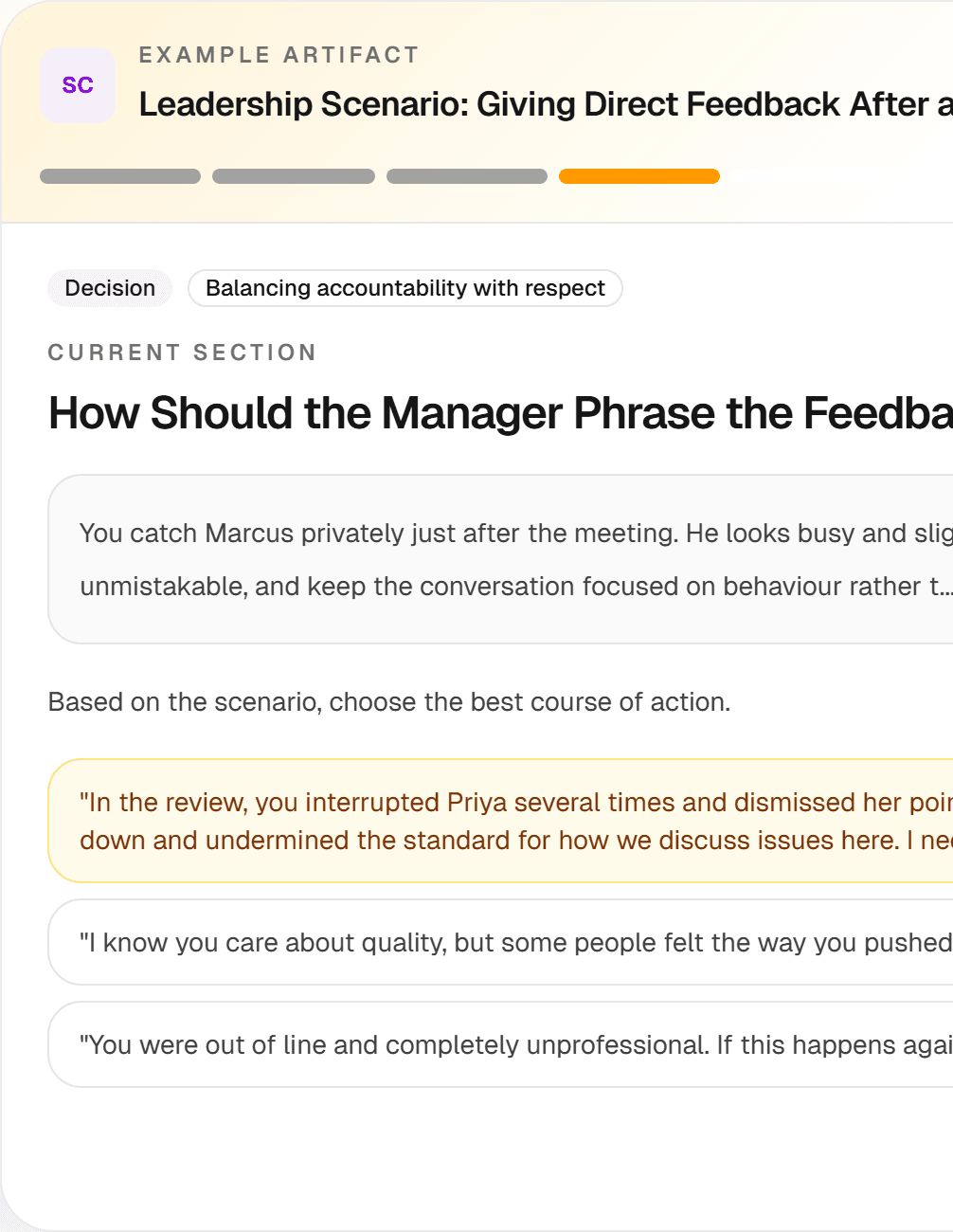
Sprint Review Reset: A Branching Feedback Scenario for First-Time Managers
A branching leadership scenario for first-time managers who must respond after a senior engineer publicly shuts down a junior colleague, covering the meeting moment, the private feedback conversation and follow-up.
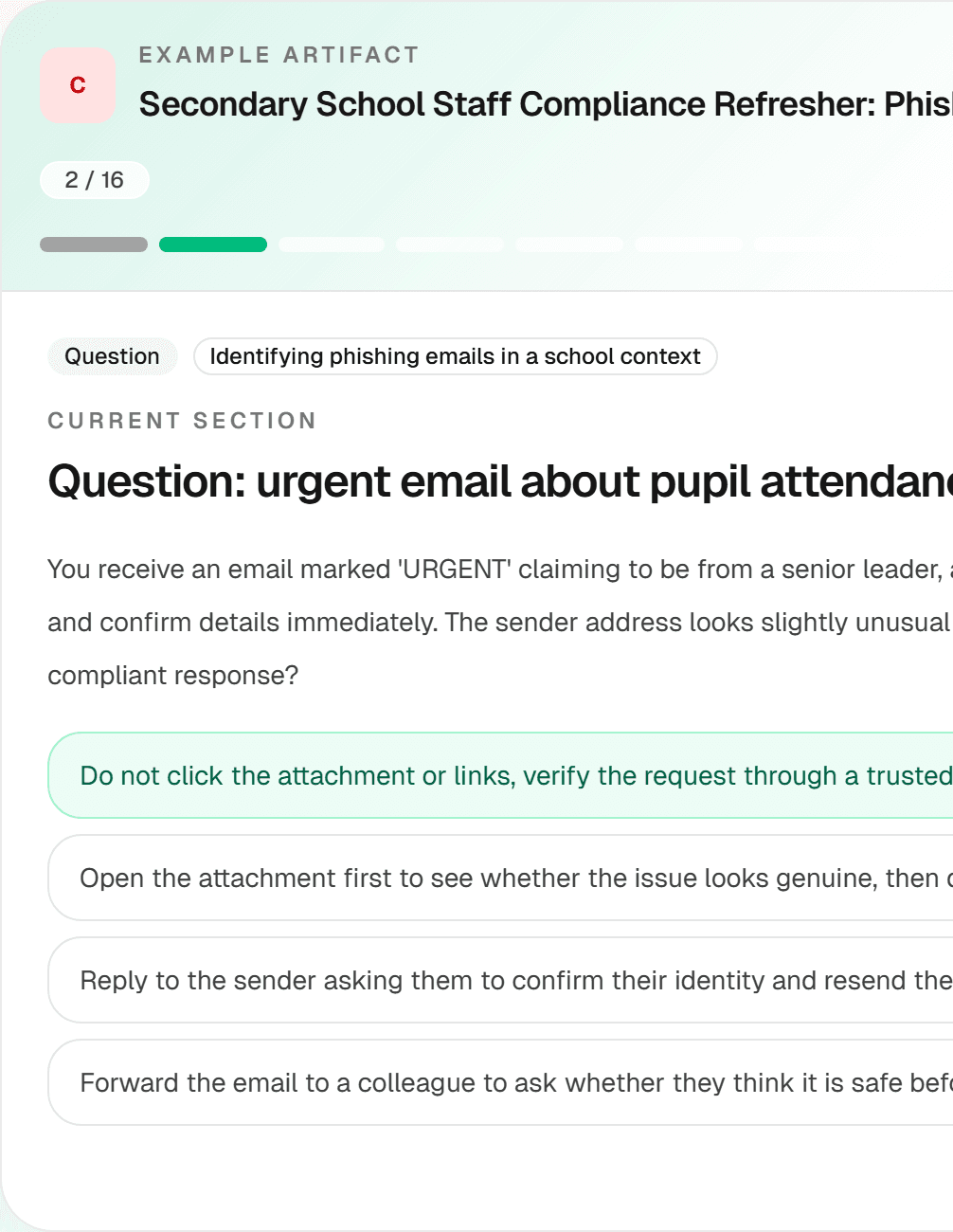
School Staff Cybersecurity and Data Protection Refresher
A phishing and pupil-data-protection refresher example for secondary school staff. Its UK GDPR and school-policy references need qualified review before use.
Build your own version
Start from this prompt and make it yours.
Use this as an illustrative starting point, then generate and review a version tailored to your team, policy context and delivery workflow.